


Chinese Literati The Essence of Chinese Calligraphy and Painting: Splendors of the Qing Empire
-
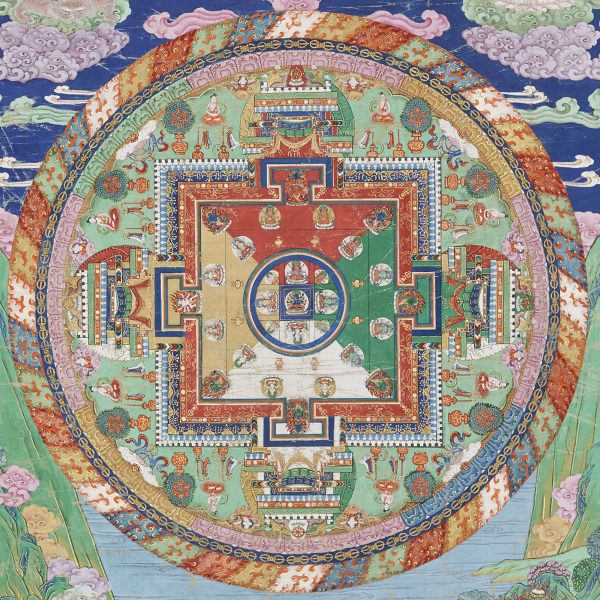
The Thirty-Two-Deity Mandala of Aksobhyavajra of the Secret Assembly Tantra (The Second Mandala of the Vajrāvalī)(detail)
China, Qing dynasty, 18th centuryAsian Gallery (Toyokan) Room 8
October 20, 2026 (Tue) - November 29, 2026 (Sun)The Essence of Chinese Calligraphy and Painting is an annual autumn exhibition showcasing outstanding works of Chinese calligraphy and painting. This year, the exhibition turns to the artistic achievements of the Qing dynasty (1644–1911), China’s final imperial dynasty.
Founded by the Manchus, a people from northeastern Asia, the Qing replaced the Ming dynasty, ruled by Han Chinese, and unified China. Supported by the empire’s abundant wealth and power, traditional culture was preserved and further developed. Imperial workshops produced refined landscape paintings grounded in the study of classical models, as well as finely detailed scenes of everyday life. Emperors and scholar-officials also took up the brush themselves, creating elegant and erudite calligraphy on richly colored and ornate paper and silk.
At the same time, Tibetan Buddhist thangkas and copperplate prints derived from Western techniques reveal the Qing empire’s broad cultural connections with the wider world. We invite you to enjoy the rich variety and splendor of Qing art and culture.
| Designation | Name | Creation/ Excavation/ Provenance |
Period | Acquisition/ Ownership/ Accession Number |
CMT | ||
| Highlight | Landscape with Pavillions in the Style of Zhao Mengfu | By Jiao Bingzhen (dates unknown), China | Qing dynasty, 17th–18th century | Gift of Dr. Hayashi Munetake, TA-444 | |||
| Highlight | The Thirty-Two-Deity Mandala of Aksobhyavajra of the Secret Assembly Tantra (The Second Mandala of the Vajrāvalī) | China | Qing dynasty, 18th century | TA-505 | |||
| Highlight | Celebrating Prosperity | By Jin Kun, Chen Mei, Sun Hu, Ding Guanpeng (possibly 1708–possibly 1771), Cheng Zhidao, and Wu Gui, China | Qing dynasty, 1740 | Private collection | |||
| Highlight | Victory Scenes from the Qing Campaigns against the Dzungars and in the Huibu Region | After original drawings by Giuseppe Castiglione and others, China, Previously owned by Mr.Okada Saburōsuke | Qing dynasty, 18th century | A-9138 | |||
| Highlight | The Investigation of Things in Running Script | By the Qianlong Emperor (1711–1799), China | Qing dynasty, 1778 | TB-913 | |||
| Poem by Chen Baisha in Running and Cursive Script | By Liu Yong (1719–1804), China | Qing dynasty, 18th century | Gift of Mr. Takashima Kikujiro, TB-1413 | ||||
| Highlight | Celebratory Poem in Running Script | By Liu Yong (1719–1804), China | Qing dynasty, 1796 | TB-1640 | |||
| Highlight | Words of Wang Ya from the New Book of Tang in Running Script | By Liang Tongshu (1723–1815), China | Qing dynasty, 18th–19th century | Gift of Mr. Aoyama San'u, TB-1620 | |||
| Highlight | The Orchid Pavilion Gathering (Qianlong Version) | Original calligraphy by Wang Xizhi (303–361) and others, China | Qing dynasty, 1780 | Gift of Dr. Hayashi Munetake, TB-1591 | |||
| Highlight | Inkstone | China, Previously owned by Mr. Aoyama San'u | Qing dynasty, 18th–19th century | Gift of Ms. Yamano Yoshiko, TB-1679 |