Barrier-Free Accessibility Information
Accessing the Museum
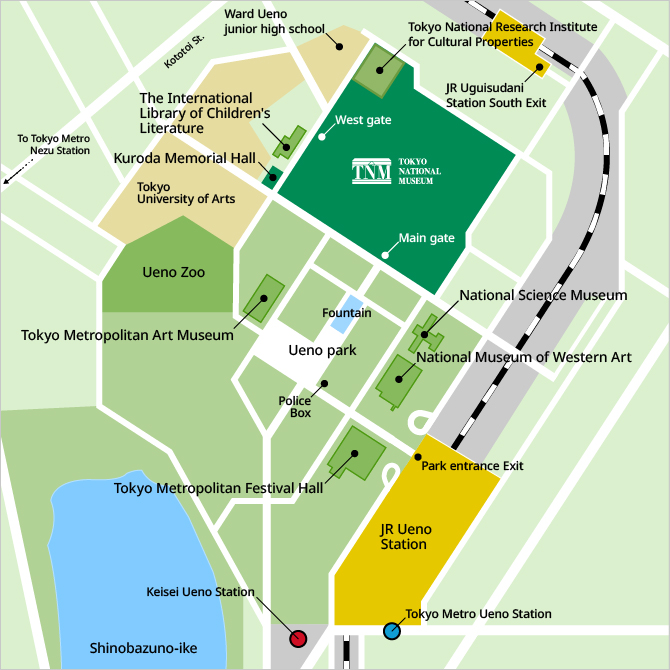
The Tokyo National Museum is located within Ueno Park. The Museum’s main entrance faces Tokyo Metropolitan Road 452.
Visiting by Public Transport
- The main entrance to the museum is located about 500 meters (0.3 miles) from the closest station, JR Ueno Station (Park Exit). It is about 600 meters (0.37 mi) from the South Entrance of JR Uguisudani Station. If you are coming from Uguisudani Station, the pedestrian pathway might be narrow in some places, and there also might be steep declines. Please watch your step if you choose to come from this station.
- From Tokyo Metro Ueno Station, Nezu Station, or Keisei Ueno Station, the Museum is about 800 to 1200 meters (0.5 to 0.75 mi) away. Please watch your step as there are steep inclines and stairs on this route.
- You can also take the Taito City Circulation Bus, “Megurin”, to the stop “In Front of Tokyo National Museum”, which is about 100 meters (330 ft) from the entrance.
- Audio access map for visually-impaired visitors from Ueno Station is available.
- Please use the following link to “Taito City Homepage: Barrier-Free Map” to find your own route from the closest train station.
Visiting by Car
- The Tokyo National Museum does not have a parking lot or bicycle parking area.
- Visitors with disabilities may use the free dedicated parking lot. As parking spaces are limited, please call 03-3822-1111 before visiting.
- For nearby parking facilities and more detailed access information, please visit the “Transportation, Admission Fees, and Opening Hours” page.
Assistance dogs
Guide dogs, service dogs, and hearing assistance dogs are permitted in the museum.
Admissions & Tickets
Disabled persons with one helper or attendant may visit the museum free of charge.
Please show your physical disability certificate or booklet at the entrance. There is no need to stop at the ticket booth.
Facilities, Equipment, and Services
Barrier-free accessibility in TNM and galleries
Explanation of barrier-free condition and accessibility information on a map.
Download all maps( PDF, 613KB)
- Main Gate area and TNM site
- Main Gate Plaza
- Honkan
- Heiseikan
- Toyokan
- The Gallery of Horyuji Treasures
- Hyokeikan
- Kuroda Memorial Hall
- Research and Information Center
Restrooms
- Multi-purpose restrooms accessible by wheelchair are available in all exhibition buildings except the Hyokeikan.
- Ostomy facilities are available in the multipurpose restrooms on the basement level of the Japanese Gallery (Honkan), the 1st floor of the Heiseikan, the 1st floor of the Toyokan, the 1st floor of the Main Gate Plaza, and the 1st floor of the Kuroda Memorial Hall.
- Diaper changing stations are available in the restrooms of the Japanese Gallery (Honkan), Heiseikan, Toyokan, Gallery of Horyuji Treasures, Main Gate Plaza, and the Kuroda Memorial Hall.
Wheelchair, Stroller, and Cane Rental
Wheelchairs, strollers, and canes are available for rental.
Wheelchairs and canes can be rented at the information counters of exhibition halls other than the Hyokeikan.
Strollers can be rented at the information counter in the Japanese Gallery (Honkan). (Quantities are limited.)
Elevators and Ramps
Elevators and ramps are available in each exhibition building, providing wheelchair access to all facilities and floors except the teahouses in the garden.
However, the Japanese Gallery and Hyokeikan feature steep ramps at their entrances and small steps of 1 to 2 centimeters (0.4 to 0.8 in.) inside the buildings. If you encounter any difficulties, please ask a nearby staff member for assistance.
Aid Station
Please inform a staff member. We will direct you to the medical aid rooms in the Honkan, Heiseikan and Toyokan.
AED (Automatic External Defribillators)
AEDs are located in every building on the Museum campus.
Lockers
Lockers are available in each exhibition hall for storing your belongings. If your items do not fit in the lockers, please approach the staff at the information counter.
Areas to Rest and Dine
- Benches and sofas are available throughout the Museum. For details, please refer to the Sensory Map of seating locations.
- Inside the Museum, there are restaurants, cafes, and food trucks where you can purchase light meals. For details, please refer to the “Restaurants & Cafes” page.
- You can eat and drink outdoors without any restrictions.
- Designated indoor dining areas are: the lounge on the first floor of the Heiseikan building, the lounge on the basement level of the Japanese Gallery (Honkan), the first floor lounge next to the main entrance of the Research and Information Center, and the covered terrace on the third floor of the Toyokan building. Eating and drinking are prohibited in all other indoor areas. However, drinking from lidded beverages is permitted in specific indoor spaces.
 PDF, 500KB)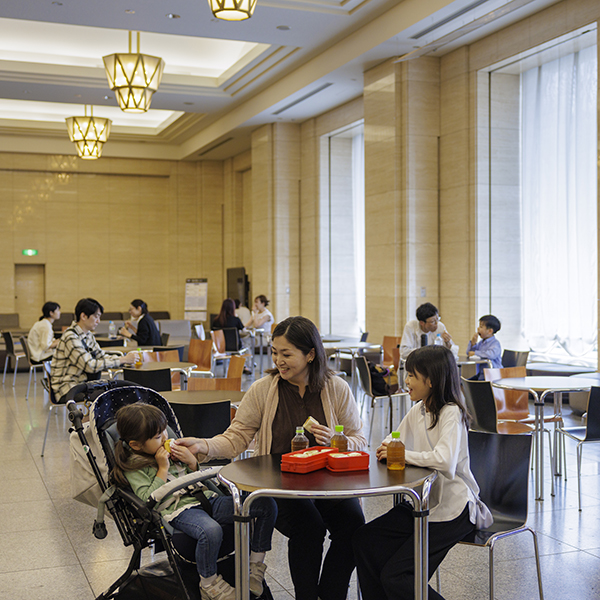
Accessibility Information for Visitors with Specific Needs and Disabilities
For Wheelchair Users and Those with Mobility Difficulties
- Visitors with disabilities may use the free dedicated parking lot. As parking spaces are limited, please call 03-3822-1111 before visiting.
- Elevators and ramps are available in each exhibition building, providing wheelchair access to all facilities and floors except the teahouses in the garden. However, the Japanese Gallery and Hyokeikan feature steep ramps at their entrances and small steps of 1 to 2 centimeters (0.4 to 0.8 in.) inside the buildings. If you encounter any difficulties, please ask a nearby staff member for assistance.
*To enter the Kuroda Memorial Hall, please use the intercom at the entrance to call a staff member.
*You may enter the garden via the path in front of THE RESTAURANT at the Tokyo National Museum(Opening on Friday, August 28), located next to the Asian Gallery (Toyokan). However, wheelchairs cannot be taken inside the teahouses within the garden (including the Tohaku Chakan). - Walking canes are permitted. If you are using other mobility aids, please inform nearby staff.
- Wheelchairs and walking canes are available for loan at the information counters of each exhibition hall.
- Wheelchair-accessible seating is available in the Auditorium of the Heiseikan. Advance notice may be required; please check the details on the respective event pages.
For Visitors Who are Hard-of-Hearing
- Writing boards are available at the information counters in each exhibition hall.
- Monthly lectures and other events held in the Heiseikan Auditorium are equipped with hearing loops (magnetic induction loops) and are compatible with the speech recognition and automatic translation app UD Talk.
Advance notice is required to use the hearing loop; please check the details on the webpage for each event.
For Visitors with Visual Disabilities
- Audio access map for visually-impaired visitors from Ueno Station is available.
- You may use a magnification application on your own smartphone or similar device when viewing the TNM Collection Exhibitions.
- For special exhibitions, permission to use magnification apps depends on the exhibition, so please approach a staff member if you wish to do so.
- The Education Space in Room 9 on the 1st floor of the Japanese Gallery (Honkan) features tactile maps that allow you to feel the characteristics of the Japanese Gallery's exhibition rooms.
- Hands-on content that feature tactile content and stamps are available in the following locations:
- Room C, 1st Floor, Japanese Gallery: Japanese Culture Plaza
- Room 9, 1st Floor, Japanese Gallery: Education Space
- Room 6, 3rd Floor, Asian Gallery: Education Space – Fortune-Telling in Asia
- 1st Floor, Heiseikan: Japanese Archaeology Gallery
(Note) Hands-on activities in Room 9 (Education Space) of the Japanese Gallery are available only when volunteer staff are present. - Audio guides for exhibition rooms and objects can be accessed via the Tokyo National Museum official viewing guide app TNM Art Guide.
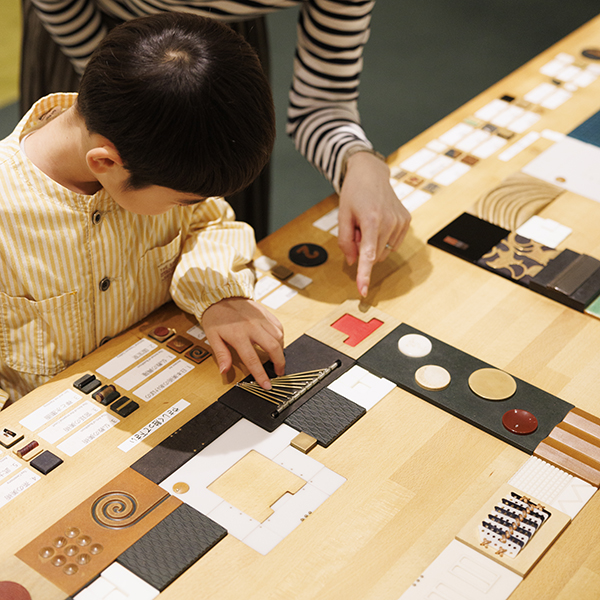 Feeling the Tactile Map
For Visitors with Sensory Sensitivities and Developmental Disabilities
- We have created Sensory Maps that show where you can sit down to rest, as well as places that might be visually and aurally overstimulating, so that you may enjoy a comfortable experience at the Museum.
Download All Sensory MapsDownload(
PDF, 3.1MB)Download Sensory Maps of Seating Areas(
PDF, 500KB)Download Sensory Maps Related to Sound(
PDF, 541KB)Download Sensory Maps Related to Light(
PDF, 1.5MB)Download Sensory Maps of the Museum's Outdoor Areas(
PDF, 423KB) - A Calm Down Space is available in the stairwell adjacent to Rooms B and C on the 1st floor of the Japanese Gallery. Feel free to use it when it is unoccupied.
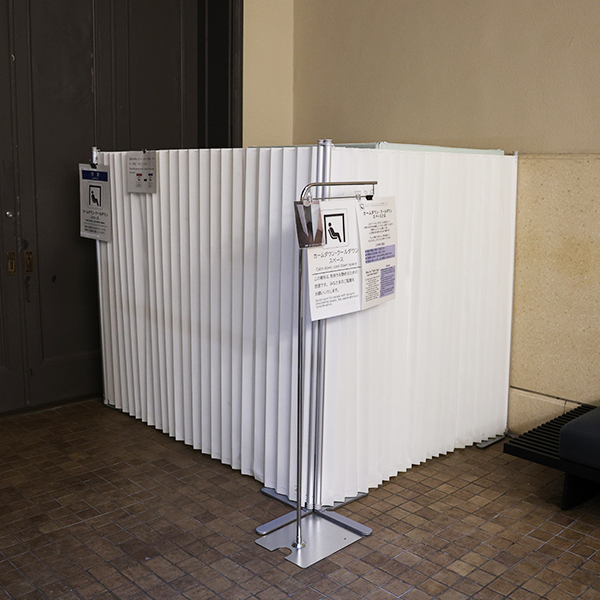 Outside the Calm Down Space
For Visitors with Children
For detailed information for families with children and family/child-friendly programs, please see the “For Visitors with Children” page.
Inquiries
For inquiries regarding barrier-free access and accessibility, please contact us via the following phone number or inquiry form.
| Phone | 03-3822-1111 (Main) |
|---|---|
| Please note that email responses may take some time. For urgent matters, please contact us by phone. |