Highlights of the Exhibition
This exhibition presents illustrated handscrolls and picture books from the collection of the Chester Beatty, organized around five thematic perspectives on Japanese narrative traditions. Alongside the museum’s celebrated masterpiece, scrolls of Song of lasting sorrow (Chōgonka gakan) by Kano Sansetsu, the exhibition brings together narrative images depicting traditional Japanese folk tales and other stories rooted in Japanese culture, offering visitors multiple ways to appreciate these works from a variety of viewpoints.* All images shown below are details.
Images courtesy of the Trustees of the Chester Beatty Library, Dublin.
A Masterpiece from the Chester Beatty: Scrolls of Song of Lasting Sorrow (Chōgonka gakan)
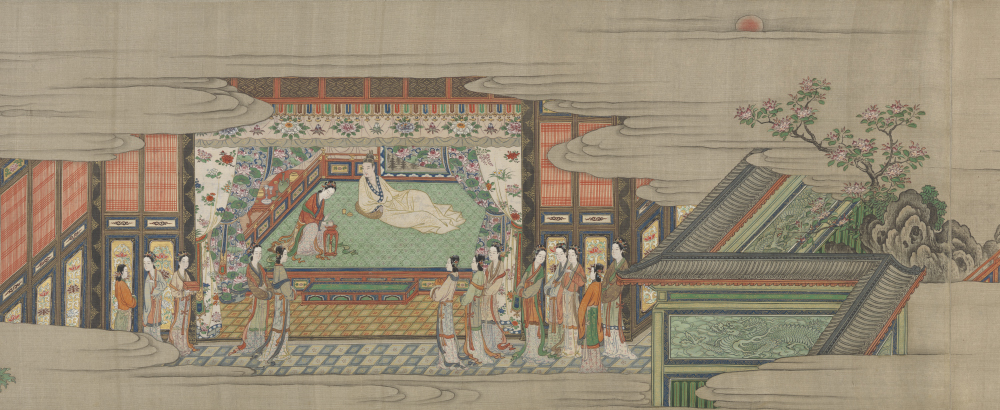
(detail)
Scroll 1 from Song of Lasting Sorrow (Chōgonka gakan), by Kano Sansetsu
Edo period, 17th century
Exhibited from April 27 – June 7 only
Song of lasting sorrow is the most famous work among the Chester Beatty’s many illustrated handscrolls and picture books. It tells the tragic love story of Emperor Xuanzong (685–762) and his consort Yang Guifei (719–756). The scroll is extravagant, making extensive use of expensive pigments to create elaborately detailed illustrations on silk. It was painted by Kanō Sansetsu (1590–1651), a Kyoto-based artist during the early Edo period (1603–1868).
Court Romances
In courtly tales such as these, emperors and court nobles play the starring roles, with their romances unfolding through the exchange of waka poems. The introduction of phonetic scripts (kana) – syllabaries better suited for writing Japanese expressions than Chinese characters – during the Heian period (794–1192) greatly contributed to the development of this early literary genre, which went on to have an enormous impact on later art and literature. The Chester Beatty’s collection of paintings of courtly tales is celebrated not only for its remarkable quality and size, but also its breadth, with works representing virtually every tale in the classical canon.
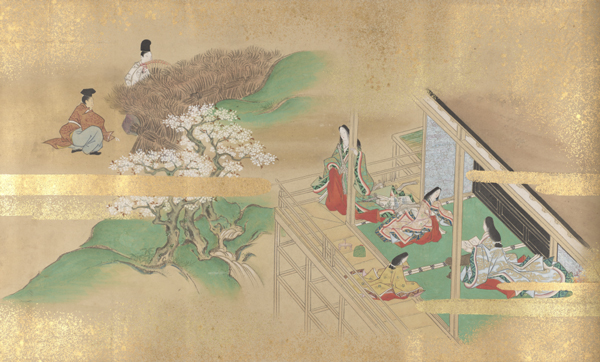
(detail)
Scroll 1 of The Tale of Genji
Edo period, ca. 1688
Illustrations and text for all fifty-four chapters of The Tale of Genji are brushed across these large handscrolls. Scenes from each chapter are depicted in bright pigments over backgrounds sprinkled with gold powder. The text in this work was brushed by twenty-seven master calligraphers. Scholars have noted they include distinguished figures with close ties to Emperor Reigen (1654–1732), like the prince-abbot Gyōjo (1640–1695) of Myōhōin Temple, suggesting the work was produced on a highly prestigious occasion and deeply cherished.
Learning from Tales of the Past
Much of Japan’s illustrated literature relates anecdotal narratives or war chronicles. The Chester Beatty owns several picture scrolls of which no similar examples have been found in Japan. Pictorialized versions of anecdotal narratives and war chronicles have been a common fixture in art since the end of the Heian period(794–1192). Illustrated anecdotal narratives and war chronicles played a critical role in helping people learn from the past and apply those lessons in the present.
In these particular genres, the Chester Beatty owns several picture scrolls of which no similar examples have been found in Japan.
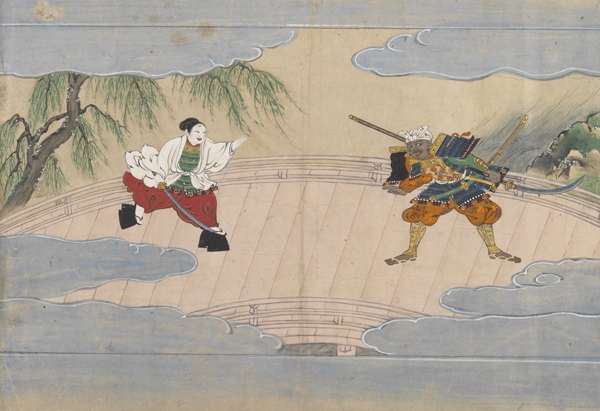
(detail)
Scroll 2 from The Tale of Musashibō Benkei
Muromachi–Edo period, 16th–17th century
This work tells of the legendary warrior-monk Musashibō Benkei, loyal retainer to the famed military commander Minamoto no Yoshitsune. Benkei is given a dark complexion in contrast to Yoshitsune’s pale skin, making it easy to distinguish the two characters. Its meticulous depiction of figures and landscapes suggests the work was produced in the late Muromachi period (1392–1573) when stories related to Yoshitsune were particularly popular.
Other Worlds and Other Worldly Beings
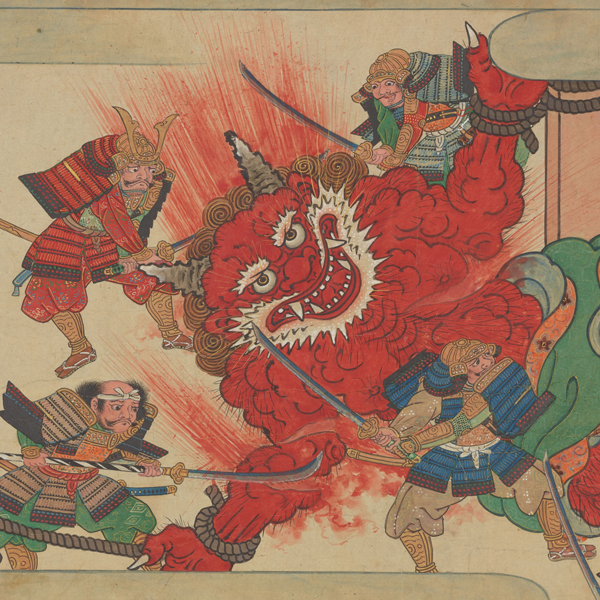
Short secular tales (otogi-zōshi) became an established genre during the late Muromachi period (1392–1573). The main characters in these stories were no longer restricted to court nobles and samurai but included ordinary people, like characters from folktales, such as Urashima Tarō and Lazy Tarō. The most popular stories were the most fantastic, often featuring interactions with other worldly creatures, like animals and demons (oni), or journeys to other worlds, like hell or distant lands. Ireland is known for its own wealth of myths and legends featuring supernatural animals, saints, and fairies. Given his heritage, perhaps this history was part of what sparked Beatty’s interest in Japanese works depicting unearthly worlds and beings.
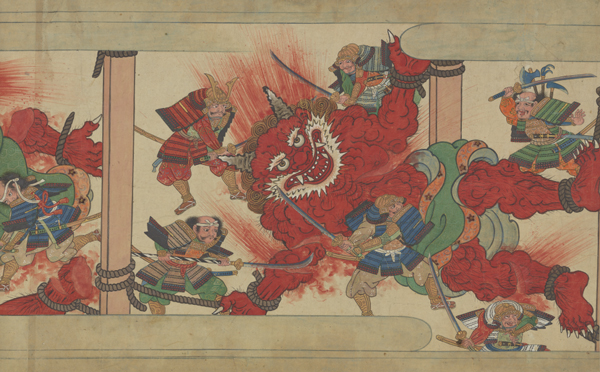
(detail)
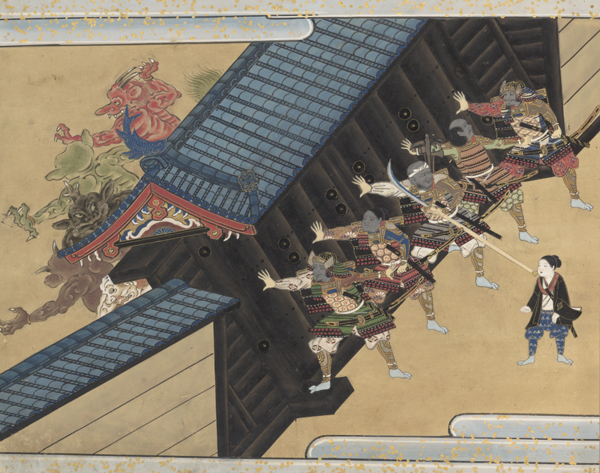
Scroll 3 from The Tale of Shutendōji (Ōeyama emaki)
Edo period, 17th century
In this tale, the demon Shutendōji is dispatched by a band of heroes led by the general Minamoto no Yorimitsu, accompanied by his four most powerful retainers. The unique appeal of the Chester Beatty version lies in how it breaks with tradition, offering an original take on the tale’s usual imagery.
Works of Imagination Inspired by the Performing Arts
New forms of ballad dramas, like Kōwaka mai and Ko jōruri, were established during the Muromachi period (1392–1573). In these much-beloved art forms, performers danced while chanting a narrative aloud to the accompaniment of music. Kōwaka mai and Ko jōruri emerged in the late medieval period. They were produced to bring the tales to life, offering visual renderings of the events described while encouraging viewers to immerse themselves further in the world of the story. The Chester Beatty is known for its extraordinary collection of paintings inspired by Kōwaka mai and Ko jōruri, with Yoshitsune’s Invasion of Hell and Tale of Muramatsu being particular highlights.
Volume 1 from Yoshitsune's invasion of hell
Edo period, 17th century
In this story, Minamoto no Yoshitsune (1159–1189) and his retainers end up in the Ashura realm of perpetual, futile warfare. Although Yoshitsune ends up presiding over hell in the tale, he is still subjected to being burned alive three times per day. On the advice of King Enma, Yoshitsune prays to the buddha Amida and is granted entry to the Pure Land. The tale is clearly likening King Enma to the emperor, and Yoshitsune to an ideal samurai serving him.
The rivalry between the emperor and warrior class at the start of the early modern period is embedded throughout this fanciful tale.
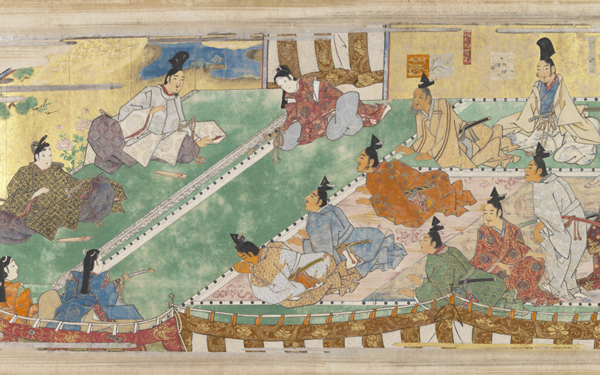
(detail)
Scroll 1 from Tale of Muramatsu
attributed to Iwasa Matabei
Edo period, 17th century
In this tale, the counsellor Kaneie is exiled to the Oki Islands for defying the Emperor’s orders after being appointed governor of Sagami and marrying into the Muramatsu clan. During his exile, a rival named Soga Shirō attacks his family, forcing Kaneie’s wife and son into a difficult life of wandering and servitude in Northern Japan. Guided by the deity Sannō Gongen, the pardoned Kaneie eventually reunites with his family and successfully defeats Soga Shirō to complete his vengeance.
This illustrated tale is thought to have been one of several sets of picture scrolls produced by the studio of Iwasa Matabei (1578–1650). The Chester Beatty’s scrolls are from the same set as the twelve scrolls belonging to the Umi-Mori Art Museum.
Admiring the Natural World
By design, the paintings in illustrated literary works are meant to accompany the text. Despite this, many scenes in illustrated handscrolls and picture books may at first appear to have little to do with the words on the page. Such paintings typically conceal a rich narrative world waiting to be discovered under the surface. Inspired by the natural phenomena and human undertakings in these works, poets composed waka poems based on them, which in turn inspired their own diverse painted expressions.
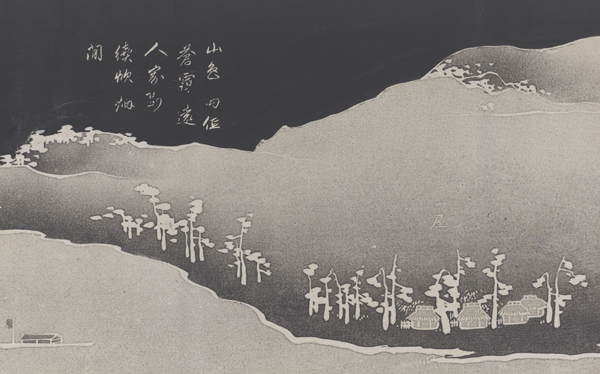
(detail)
On a riverboat journey by Itō Jakuchū
Edo period, c. 1767
The scenes in this printed handscroll drew on Jakuchū’s experience sailing down the Yodo River from Kyoto to Osaka with his friend Daiten (Baisōkenjō; 1719–1801), a Zen monk from Shōkokuji Temple.
In the scroll, Jakuchū rendered dream-like landscapes using an ink-rubbing technique, producing an uncanny effect that seems almost to invite the viewer into another dimension.
Fifteen copies of On a Riverboat Journey are currently known to exist, both in Japan and abroad, but Jakuchū’s masterpiece was created through a trial-and-error process, and each work differs somewhat in its carvings and resulting images. The Chester Beatty’s copy is thought to be the seventh one created. No other identical print has been found. The handling, where the sheets of paper are joined and the placement of the characters show improvements on earlier copies, likely indicates Jakuchū was close to the state of completion he was aiming for when he produced it. The Chester Beatty’s copy also importantly retains its original labels, adding an extra value.
About the Chester Beatty
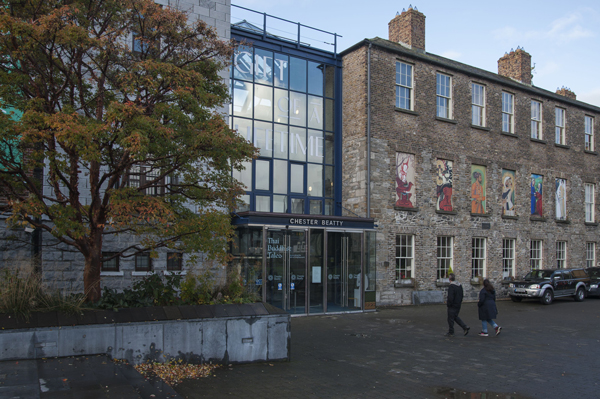
Exterior of the Chester Beatty
A National Cultural Institution located in the heart of Dublin, the capital of Ireland, the Chester Beatty is Ireland’s leading museum of world cultures. It houses over 25,000 cultural artefacts gathered from around the world by Sir Alfred Chester Beatty, an Irish-American businessman born in New York. Beatty transformed his private collection into a public library with a gallery space, essentially creating a museum. It relocated to the grounds of Dublin Castle in 2000, further strengthening its character as a "window on the world."
The museum possesses valuable cultural objects, mainly manuscripts and rare books from Europe, the Middle East, North Africa, and Asia. Through these collections, it strives to promote understanding and appreciation of world culture.
The Japanese art collection totals over 1,900 items. In addition to the picture books and picture scrolls currently on display, it also holds Edo period surimono (privately published prints), inrō (case for holding small objects), and netsuke (miniature sculptures). It plays a role as a centre for the study and dissemination of Japanese culture in Europe.



 (241KB)