


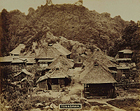
Japanese Gallery (Honkan) Room 16
June 7, 2011 (Tue) - July 18, 2011 (Mon)
Photography was invented in 1839 by a French man named Louis Daguerre. Several decades later, this technology found its way to Japan and it now became possible to capture images of the Japanese people and their society. The technology arrived in time to witness the collapse of the shogunate and the end of the Edo period (1603-1867). It was also there record the start of the Meiji period, a time when the new Japanese government was striving to create a modern nation state. As with other scientific and technological advances, photography soon began to attract Japanese students, who began to record the changing face of Japan.
Whilst capturing remnants of a disappearing Edo period, such as castles, villages, street scenes, temples and shrines, these photographers also snapped symbols of modernization such as government offices, factories, roads, bridges and lighthouses. As a building symbolizing the new era, this museum’s original Honkan building was also a popular subject.
This exhibition features images from early-period Meiji photo collections such as the Photo Album of Edo Castle and Jinshin Survey Photographs, both Important Cultural Properties. These photographs, taken by representative photographers from the era such as Yokoyama Matsusaburo and Uchida Kuichi, depict the rapid shift from the Edo to the Meiji period.
 Major works in this exhibition