


Researching and Conserving Artifacts of Early Japanese Christianity
-
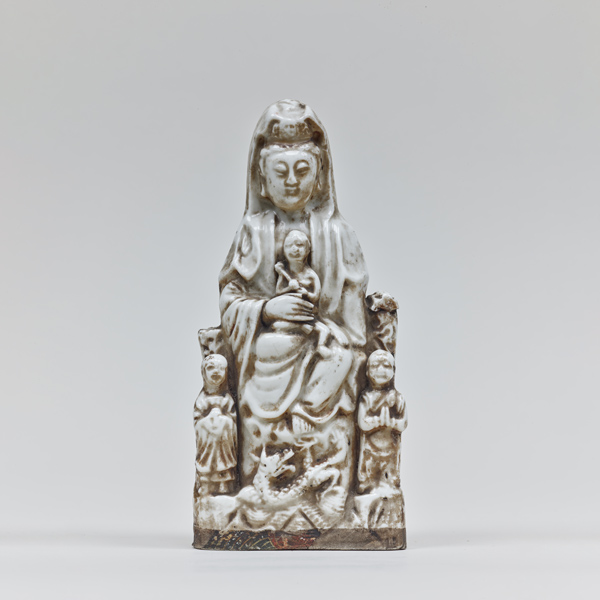
The Bodhisattva Kannon
Dehua ware, China, Previously owned by the Nagasaki Magistrate's Office (stored in 1856), Ming–Qing dynasty, 17th century (Important Cultural Property)Japanese Gallery (Honkan) Room 4
April 8, 2026 (Wed) - May 10, 2026 (Sun)The current exhibition presents artifacts related to Christianity from Japan’s early modern period. The religion was introduced to Japan in the mid-1500s, but it was outlawed at the beginning of the Edo period (1603–1868). On display here are objects from the 1500s, including those that had been stored at the Nagasaki Magistrate’s Office in southern Japan. These consist of items that were confiscated from Christians in various parts of Nagasaki, as well as “stepping images” known as fumi-e, which were used by the Edo-period government to identify Christians for persecution.
Among these objects are glazed porcelain figures of the bodhisattva Kannon, which were made in Dehua, southern China. To escape persecution, it is believed that Japanese Christians at the time worshipped these figures asrepresentations of the Virgin Mary. The present exhibition introduces these Kannon figures as well as other sculptures that are thought to have been objects of worship.Also featured here are the museum’s recent efforts to improve the storage conditions of Christian-related objects, which also include pieces of cloth called scapulars that Christians carried around for protection.
| Designation | Name | Creation/ Excavation/ Provenance |
Period | Acquisition/ Ownership/ Accession Number |
CMT | ||
| Highlight | Important Cultural Property | The Bodhisattva Kannon | Dehua ware, China, Previously owned by the Nagasaki Magistrate's Office (stored in 1856) | Ming–Qing dynasty, 17th century | C-600 | ||
| Important Cultural Property | Madonna of the Thumb | Italy, Previously owned by the Nagasaki Magistrate's Office | 17th century | C-698 | |||
| Highlight | Important Cultural Property | The Bodhisattva Kannon | Dehua ware, China, Previously owned by the Nagasaki Magistrate's Office (stored in 1856) | Ming–Qing dynasty, 17th century | C-607 | ||
| Highlight | Important Cultural Property | The Bodhisattva Kannon | Dehua ware, China, Previously owned by the Nagasaki Magistrate's Office (stored in 1856) | Ming–Qing dynasty, 17th century | C-618 | ||
| Highlight | Important Cultural Property | The Bodhisattva Kannon | Longquan ware, China | Ming–Qing dynasty, 17th century | C-1087 | ||
| Highlight | Important Cultural Property | Scapular | Europe | 19th century | C-1001-1 |