


Calligraphy and Textiles
-
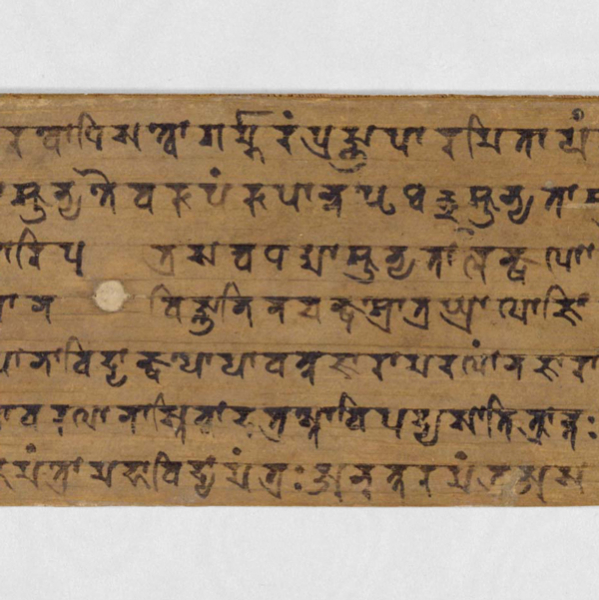
Heart Sutra and Dharani Mantra in Sanskrit (detail)
Late Gupta dynasty, 7th-8th century (Important Cultural Propert)The Gallery of Horyuji Treasures Room 6
July 30, 2024 (Tue) - August 25, 2024 (Sun)The works of calligraphy held in the Gallery of Horyuji Treasures primarily consist of records donated to the temple by Empress Kōken (713–770), works imported from China during the Tang dynasty (618–907), and Horyuji Temple’s records of daily events as well as legends concerning Prince Shōtoku.
The textiles held in the collection date from the mid-7th to 8th century and consist mainly of Buddhist ritual banners (ban), table mats (joku), and robes or other clothing worn by monks. The textiles also include fragments whose original uses are unknown, including rare ancient textiles, such as warp-faced compound weaves, tapestries, warp ikat fragments, complex gauze (ra), and plain- and twill- weave silks.
Dyed fabrics include examples of all three major dyeing techniques form the 8th century: tie-dyeing in a dot pattern (kōkechi), wax-resist dyeing (rōkechi), and clamp-resist dyeing (kyōkechi). The collection also features examples of early embroidery, braiding, and rugs.
Calligraphy
| Designation | Name | Creation/ Excavation/ Provenance |
Period | Acquisition/ Ownership/ Accession Number |
CMT | ||
| Highlight | Important Cultural Property | Heart Sutra and "Dharani" Mantra in Sanskrit | Late Gupta dynasty, 7th-8th century | N-8-1 | |||
| Transcription of the Heart Sutra and "Dharani" Mantra in Sanskrit with annotations in Chinese | By Jogon | Edo period, 1694 | N-8附属 | ||||
| Fragment of the "Sutra of the Wise and Foolish" (Ōjōmu) | Nara period, 8th century | N-11 | |||||
| Sutra of the Buddhas’ Names | Heian period, 1141 | N-14-1 |
Textiles
| Designation | Name | Creation/ Excavation/ Provenance |
Period | Acquisition/ Ownership/ Accession Number |
CMT | ||
| Highlight | Important Cultural Property | Four Fragments of a Sash | Asuka period, 7th century | N-47 | |||
| Highlight | Important Cultural Property | Fragment of a Banner ("Ban") with Lion and Phoenixes | Asuka period, 7th century | N-56 | |||
| Important Cultural Property | White Rug | Nara period, 8th century | N-54-1 |