


Dated Mirrors and Inherited Mirrors
-
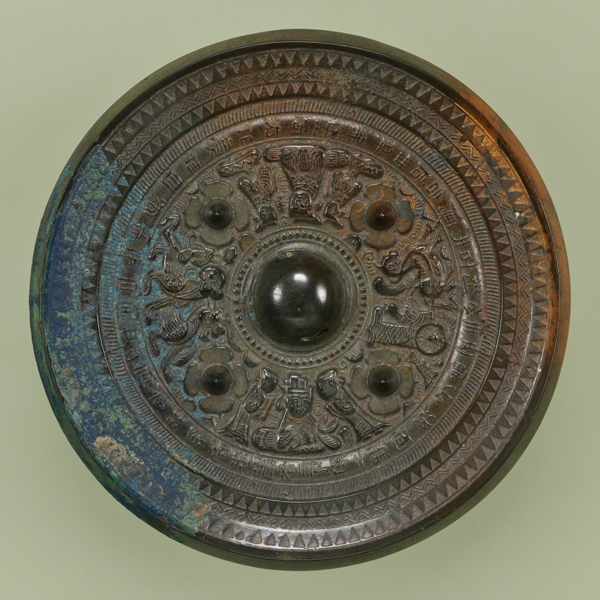
Mirror with Deities, Mythical Beasts, and a Chariot
Found at the Samita Takarazuka Tumulus, Nara, Kofun period, 4th–5th century; created in China, 2nd–3rd century (Important Cultural Property)Japanese Archaeology and Special Exhibition (Heiseikan) Japanese Archaeology Gallery
April 8, 2026 (Wed) - December 6, 2026 (Sun)The mirrors displayed here comprise two types: ones inscribed with their respective years of production, and ones that were passed down through multiple generations before burial in tomb mounds. The former type are inscribed with Chinese era names from dynasties such as the Wei (220–265) and the Wu (222–280), and have been excavated in limited number from Japanese tomb mounds. The latter were buried in tomb mounds years after being produced, and are invaluable for shedding light on the establishment of Kofun-period culture.
| Designation | Name | Creation/ Excavation/ Provenance |
Period | Acquisition/ Ownership/ Accession Number |
CMT | ||
| Highlight | Important Art Object | Mirror with a TLV Pattern and Four Deities | Found at Tsuruo Shrine Tumulus No. 4, Kagawa | Kofun period, 3rd–4th century; created in China, 1st–2nd century | Private collection | ||
| Highlight | Important Cultural Property | Mirror with Deities, Mythical Beasts, and a Chariot | Found at the Samita Takarazuka Tumulus, Nara | Kofun period, 4th–5th century; created in China, 2nd–3rd century | J-176 | ||
| Highlight | Important Cultural Property | Mirror with Deities and Beasts | Found at the Tori'ibaru Tumulus, Yamanashi | Kofun period, 4th century; created in China, dated 238 | Lent by Ichinomiya Asama Shrine | ||
| Highlight | National Treasure | Mirror with Human Figures | Passed down at Suda Hachiman Shrine, Wakayama | Kofun period, 5th–6th century; created in China, dated 443 or 503 | Lent by Suda Hachiman Shrine, Wakayama |