


Lacquerware
-
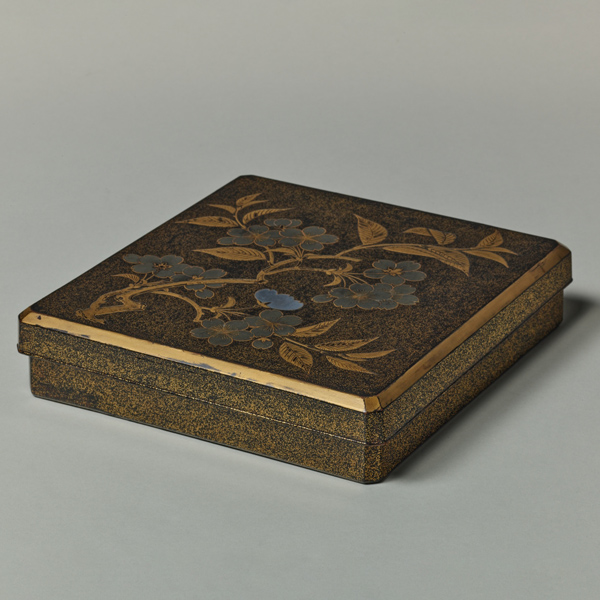
Writing Box with Cherry Blossoms
Muromachi period, 15th–16th centuryJapanese Gallery (Honkan) Room 12
March 17, 2026 (Tue) - April 5, 2026 (Sun)Lacquer is the sap of the lacquer tree, which grows in East and Southeast Asia. Naturally sticky, it can be brushed onto different materials, and hardens into a durable coating that is waterproof and resistant to acids, alkalis, and heat. Because of its versatility and beauty, lacquer has been central to daily life in parts of Asia for over 9,000 years.
In Japan, artisans coated everyday items with lacquer, including furniture, boxes, dining sets, and cosmetic and writing tools. The base material could be wood, pottery, cloth, leather, or paper. To decorate these items, artisans painted designs with a mixture of lacquer and pigment, or used lacquer like a glue to inlay metal and mother-of-pearl.
But the pinnacle of lacquer decoration in Japan is maki-e (sprinkled picture). It consists of painting a design with lacquer, and then sprinkling metal powders onto the sticky lacquer before it hardens. Artisans first used maki-e techniques in the 8th century. As shown in this gallery, they developed them to an extraordinary degree over the centuries.
| Designation | Name | Creation/ Excavation/ Provenance |
Period | Acquisition/ Ownership/ Accession Number |
CMT | ||
| Highlight | National Treasure | Box for Monastic Robes Decorated with a Seascape | Heian period, 10th century | Lent by Kyō'ōgokokuji Temple, Kyoto | |||
| Highlight | Important Cultural Property | Writing Box with Mount Hatsuse | Muromachi–Azuchi-Momoyama period, 16th century | H-4524 | |||
| Highlight | Transverse Flute (Ryūteki), Named "Hō'ō (Pheonix)" | By Iizuka Tōyō I (possibly 1725–1790) | Flute: Kamakura period, 13th century; case: Edo period, 18th century | H-3815 | |||
| Highlight | Writing Box with a Pine and Camellia | Muromachi period, 15th century | H-4614 | ||||
| Writing Box with Cherry Blossoms | Muromachi period, 15th–16th century | H-40 | |||||
| Highlight | Miniature Shrine with a Lotus Pond; Stupa-Shaped Buddhist Reliquary | Shrine carved by Dōen and decorated by Igarashi; reliquary by Gotō Teijō, Previously owned by Rengeji Temple, Kyoto | Edo period, 1672 | H-4633 |