


The Art of Fashion | 17th–19th century
-
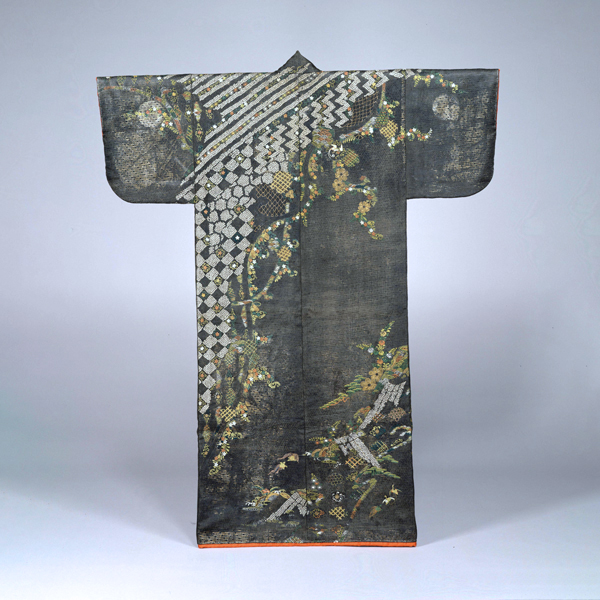
Kimono (Kosode) with Plants, Cranes, Turtles, and Geometric Patterns, Edo period, 17th century (Important Cultural Property)
Japanese Gallery (Honkan) Room 10
January 2, 2024 (Tue) - March 3, 2024 (Sun)Japan's traditional clothing, kimono, are based on kosode — the outerwear of the Edo period (1603–1868). At first, the court nobility and samurai wore them under other clothing. But from about the 15th century, the samurai began using them as daily outerwear. In the 17th century, kosode became the most common clothing for men and women of all classes.
Wealthy women placed orders for custom-made kosode at luxury clothing stores. They often chose the patterns from clothing-design books that were published and widely circulated. Together with these kosode, they wore hairpins and combs to accent their elaborate hairstyles.
In contrast, men wore kosode with understated patterns like stripes or checks.
Their usual fashion accessories were a small case (inrō) and a toggle (netsuke) for securing the case to the sash. This gallery features kosode and accessories, together with prints and paintings (ukiyo–e) showing how people wore them and how fashions changed over time.
| Designation | Name | Creation/ Excavation/ Provenance |
Period | Acquisition/ Ownership/ Accession Number |
CMT | ||
| Highlight | Important Cultural Property | Kimono ("Kosode") with Plants, Cranes, Turtles, and Geometric Patterns | Edo period, 17th century | I-4092 | |||
| Highlight | Gift Cover ("Fukusa") with Sea Breams | Edo period, 18th–19th century | Gift of Mrs. Henry, I-3787-3 | ||||
| Highlight | Formal Outer Kimono ("Uchikake") with Pines, Bamboo, Plum Blossoms, Cranes, and Treasures | Edo period, 18th century | Gift of Mrs. Henry, I-3767 | ||||
| Highlight | Sash ("Obi") with "Myriad Treasures" and "Noshi" Strips | Edo period, 18th–19th century | I-4277 | ||||
| Highlight | Case ("Inrō") with the Immortal Zhang Guolao | Edo period, 19th century | Gift of Mr. Quincy A. Shaw, H-325 |