


People on the Japanese Archipelago during a Glacial Stage: The Dawn of Tool Making
-
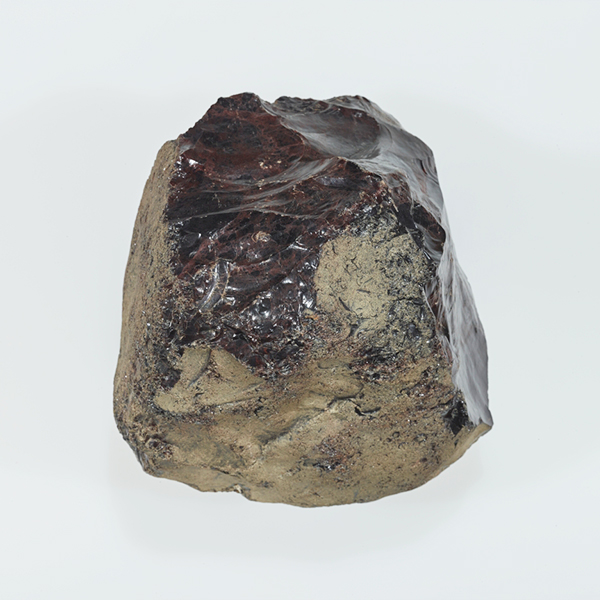
Raw Material (Obsidian) for Stone Tools
Excavated at Shirataki, Engaru-cho, Hokkaido, Paleolithic period, 18000 BC (Gift of Mr. Matsudaira Yoshito)Japanese Archaeology and Special Exhibition (Heiseikan) Japanese Archaeology Gallery
April 8, 2026 (Wed) - September 6, 2026 (Sun)People first settled in Japan about 40,000 years ago, marking the beginning of the Paleolithic period, which continued until pottery was rst created approximately 13,000 years ago. This period coincided with a glacial stage during which Japan was still connected to the Asian continent via land bridges and inhabited by large mammals such as mammoths. People led nomadic lives and made tools from stone and animal bone, using them to hunt and forage.
This section explores how Paleolithic tools changed over time through common examples: trapezoids with cutting edges, knives, spearheads, and miniature blades for making composite tools such as harpoons. Generally, Paleolithic tools were made by chipping stone into the desired shapes, while polished stone tools firrst appeared in the following Neolithic period. Japan’s Paleolithic period, however, is characterized by the use of stone axe heads with partially-polished blades.The most common material for tools was obsidian, a type of volcanic glass found in abundance across most of Japan. The sedimentary rock siliceous shale was used in northeastern Japan, where obsidian was scarce, while the volcanic rock sanukite was used in the Kinki region and around the Seto Inland Sea. All of these materials were suitable for making tools because they were relatively hard and ne-grained, allowing sharp edges to be formed by chipping.
| Designation | Name | Creation/ Excavation/ Provenance |
Period | Acquisition/ Ownership/ Accession Number |
CMT | ||
| Highlight | Lithic Core (Source Material for Stone Tools) | Found in Engaru Town, Hokkaido | Paleolithic period, 18,000 BC | Gift of Mr. Matsudaira Yoshito, J-39521-7 | |||
| Highlight | Polished Axes | Found at the Kannoki Site, Nagano | Paleolithic period, 35,000 BC | Lent by the Nagano Prefectural Museum of History, Nagano | |||
| Highlight | Backed Blades | Found at the Kannoki Site, Nagano | Paleolithic period, 35,000 BC | Lent by the Nagano Prefectural Museum of History, Nagano | |||
| Highlight | Microblades | Found at the Oketo Azumi Site, Hokkaido | Paleolithic period, 18,000 BC | Gift of Mr. Matsudaira Yoshito, J-39524-1 | |||
| Highlight | Microcore | Found at sites No. 4 and No. 30 of the Shirataki Site, Hokkaido | Paleolithic period, 18,000 BC | Gift of Mr. Matsudaira Yoshito, J-39520-3 | |||
| Projectile Point | Found at Shimo-shanafuchi Site, Hokkaidō | Paleolithic period, 18,000 BC | Gift of Mr. Matsudaira Yoshito, J-39519-1 | ||||
| Highlight | Gravers | Found at the Araya Site, Niigata | Paleolithic period, 16,000 BC | Gift of Mr. Hoshino Ryo, J-38449-1 | |||
| Highlight | Stemmed Projectile Point | Found at the Kasori Shell Mound, Chiba | Jōmon period, 11,000–7000 BC | J-23247 |