


Asian Textiles—Indonesian Textiles
-
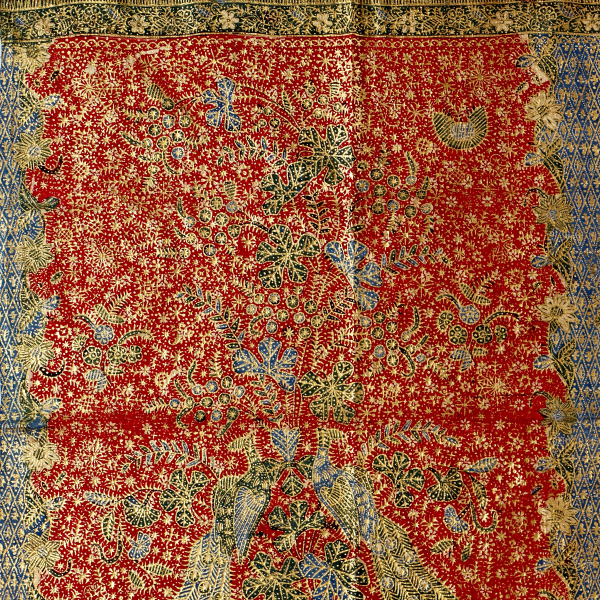
Waistcloth (Sarong) with Peacocks and Bouquets (detail)
Java, Indonesia, Early 20th centuryAsian Gallery (Toyokan) Room 13
September 8, 2026 (Tue) - November 29, 2026 (Sun)Indonesia, which lies between the Indian and Pacific oceans, consists of many islands, with each island or tribe possessing a distinctive culture. From about the end of the 18th century, unique dyes and techniques for dyeing cotton with designs were used to begin the production of batik cloth. To make batik, a detailed design is applied in wax using either a metal stamp known as a cap, or a tool called a canting that pours the wax. The cotton is then dyed with indigo and a vegetable-based, dark brown soga dye. At lively events like weddings, dazzling clothes are worn that feature designs in gold leaf on batik cloth interwoven with gold threads. Ikat fabric, which is used in ceremonies or celebrations and has patterns created by weaving splash-dyed threads, also features a profusion of individual designs almost as numerous as the number of Indonesia’s islands.
| Designation | Name | Creation/ Excavation/ Provenance |
Period | Acquisition/ Ownership/ Accession Number |
CMT | ||
| Highlight | Formal Waist Cloth (Dodot) with Garuda and Flowering Plants | Central Java, Indonesia | Start of the 20th century | TI-349-9 | |||
| Highlight | Waistcloth (Sarong) with Peacocks and Bouquets | Java, Indonesia | Start of the 20th century | TI-349-8 | |||
| Highlight | Shawl with Floral Checks and a Sawtooth Pattern | Palembang, Sumatra, Indonesia | 19th century | TI-266 | |||
| Highlight | Shoulder Cloth (Kain Limar) with Diamonds, Paisley Cones, and Flowers | Palembang, Sumatra, Indonesia | 19th–20th century | TI-147 | |||
| Highlight | Ceremonial Hanging Cloth (Palepai) with a Sacred Ship | Lampung, Sumatra, Indonesia | 20th century | TI-353 |