


After the Jōmon Period in Hokkaido: Epi-Jōmon, Okhotsk, and Satsumon Cultures
-
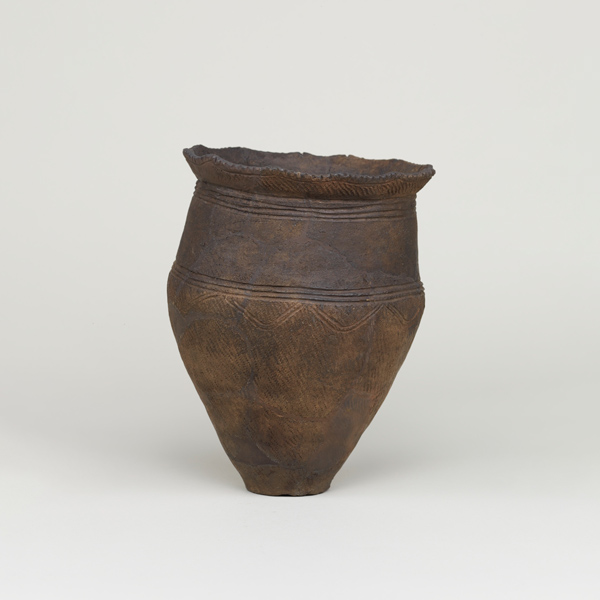
Deep Vessel
Found in Muroran City, Hokkaido, Epi-Jōmon period, 4th century BC–1st century AD (Gift of Mr. Watanabe Matazō)Japanese Archaeology and Special Exhibition (Heiseikan) Japanese Archaeology Gallery
April 8, 2026 (Wed) - September 6, 2026 (Sun)After the Jōmon period (ca. 11,000 BC–5th century BC), a unique culture based on fishing, hunting, and gathering developed in Hokkaido as rice cultivation did not take root due to the cold climate. This culture in effect comprises of the following three cultures: the Epi-Jōmon culture (4th–7th century BC), the Okhotsk culture (5th–12th century; lasting until the 9th century in Hokkaido), and the Satsumon culture (7th–12th century).
The primary subsistence activities of the Epi-Jōmon culture were fishing and hunting. Many archaeological sites and shell mounds were concentrated along coastlines and river basins. Fishing tools representative of this culture include fish-shaped stone objects, thought to be artificial lures, and richly decorated bone and antler spearheads.
The subsequent Satsumon culture emerged under the influence of ancient states on Honshū, the main island of the Japanese archipelago. People from this time built square pit dwellings equipped with hearths, made pottery (“Satsumon pottery”) influenced by haji earthenware, and began using ironware extensively. Many ironware products were obtained through trade with people in the northernmost part of Honshū, who in exchange obtained eagle and hawk feathers, animal furs, and marine products.
The Okhotsk culture centered on fishing and marine-mammal hunting as its primary subsistence activities. It spread from the mouth of Amur River across all of Sakhalin, along the Okhotsk coast of Hokkaido, and to the Kuril Islands. In Hokkaido, the Okhotsk culture was a foreign culture that came from the north and coexisted at times with the Jōmon and Satsumon cultures. This exhibition displays pottery, stone tools, bone and antler tools, and metal objects representative of these three cultures.
| Designation | Name | Creation/ Excavation/ Provenance |
Period | Acquisition/ Ownership/ Accession Number |
CMT | ||
| Highlight | Deep Vessel | Found in Muroran City, Hokkaido | Epi-Jōmon period, 4th century BC–1st century AD | Gift of Mr. Watanabe Matazō, J-8926 | |||
| Highlight | Spouted Vessel | Found on the Hokkaido University grounds, Hokkaido | Epi-Jōmon period, 2nd–7th century | J-23770 | |||
| Highlight | Fish-Shaped Stone | Found in an unknown location | Epi-Jōmon period, 4th century BC–1st century AD | J-2754 | |||
| Fish-Shaped Stone | Found in an unknown location | Epi-Jōmon period, 4th century BC–1st century AD | Gift of Mr. Tokugawa Yorisada, K-28658 | ||||
| Highlight | Scraper | Found in Yoichi Town, Hokkaido | Epi-Jōmon period, 2nd–7th century | J-1312 | |||
| Highlight | Jar | Found in Esashi Town, Hokkaido | Okhotsk Culture period, 6th–7th century | J-22410 | |||
| Highlight | Harpoon Head | Found at the Dachnoye Susuya Shell Mound, Russia | Okhotsk Culture period, 5th–12th century | J-16310 | |||
| Highlight | Accessory-Shaped Object | Found at the Solovyovka South Shell Mound, Russia | Okhotsk Culture period, 5th–12th century | Gift of Mr. Tokugawa Yorisada, J-16318 | |||
| Highlight | Pot | Found in a farm of Hokkaido University, Hokkaido | Satsumon period, 7th–8th century | J-1541 | |||
| Highlight | Sword with a Curled Pommel (Warabite) | Found at the Kashiwagi Higashi Site, Hokkaido | Satsumon period, 8th century | J-34274 | |||
| Highlight | Fragment of a Spindle Whorl | Found on the grounds of a coalmine railway office, Hokkaido | Satsumon period, 10th–12th century | Gift of the Hokkaido Project Management Bureau, Ministry of Agriculture and Commerce, J-4676 |