


Permanent Settlements and the Creation of Pottery
-
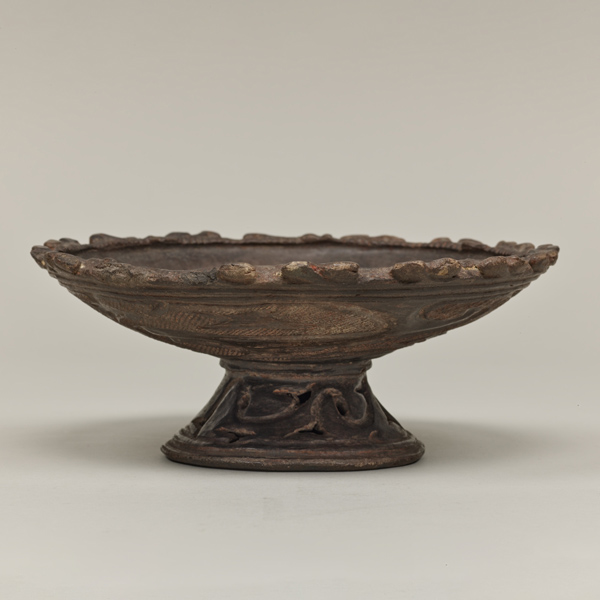
Footed Shallow Bowl
Found in Tsugaru City, Aomori, Jōmon period, 1000–400 BCJapanese Archaeology and Special Exhibition (Heiseikan) Japanese Archaeology Gallery
April 8, 2026 (Wed) - September 6, 2026 (Sun)Rising sea levels formed the Japanese islands when the ice age ended about 13,000 years ago. In response to their changing environment, people began using the bow and arrow for hunting, invented pottery, and began living in permanent settlements. This was the beginning of Japan’s Neolithic era, which lasted for approximately 10,000 years. Although farming and the rearing of livestock usually began during this era in other societies, life in Japan continued to be centered on foraging, fishing, and hunting.
| Designation | Name | Creation/ Excavation/ Provenance |
Period | Acquisition/ Ownership/ Accession Number |
CMT | ||
| Highlight | Rod | Found in Komagane City, Nagano | Jōmon period, 3000–2000 BC | J-1474 | |||
| Highlight | Deep Vessels | Found at the Hanamiyama Site, Kanagawa | Jōmon period, 11,000–7000 BC | Lent by the Yokohama City Board of Education, Kanagawa | |||
| Highlight | Deep Vessel | Found in Niigata City, Niigata | Jōmon period, 4000–3000 BC | Gift of Mr. Uehara Kōshirō, J-39544 | |||
| Highlight | Deep Vessel | Found at the Kawanishi Elementary School Site, Tochigi | Jōmon period, 3000–2000 BC | J-22775 | |||
| Highlight | Deep Vessel | Found at the Ubayama Shell Mound, Chiba | Jōmon period, 3000–2000 BC | Gift of Mr. Sugihara Sōsuke, J-34544 | |||
| Highlight | Deep Vessel | Found at the Azusawa Shell Mound, Tokyo | Jōmon period, 2000–1000 BC | Gift of Mr. Goto Shuichi, J-23165 | |||
| Highlight | Footed Shallow Bowl | Found in Tsugaru City, Aomori | Jōmon period, 1000–400 BC | J-36814 |